
Helped my neighbor measure his driveway last month. He’s planning a garage. Contractor quoted him 20×20 feet.
“Is 400 square feet enough for two cars?”
Looked at his F-150 and his wife’s Tahoe sitting there.
“Technically? Yeah. Realistically? You’ll hate it.”
Built it anyway. Now he can’t open his doors without hitting stuff.
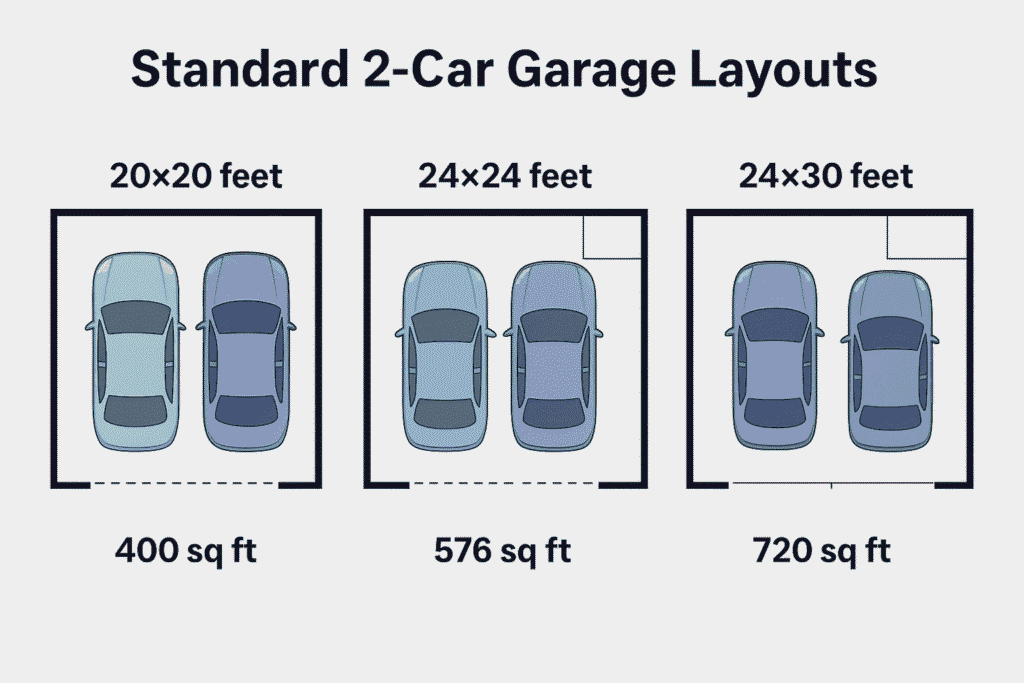
How many square feet is a 2-car garage? Anywhere from 400 to 720 square feet depending on who you ask. Common builds are 20×20 (400 sq ft), 24×24 (576 sq ft), or 24×30 (720 sq ft).
But asking about the square footage of a 2-car garage is like asking “how big is a bedroom”—depends what you’re putting in it and whether you want to move around.
How Many Square Feet for a 2-Car Garage: Standard Sizes Explained
Builders throw around the word “standard” like it means something universal. It doesn’t.
| Garage Dimensions | Total Square Feet | What This Actually Means |
|---|---|---|
| 20×20 feet | 400 sq ft | Hope you’re good at parking |
| 20×22 feet | 440 sq ft | Slightly less hope required |
| 22×22 feet | 484 sq ft | Getting somewhere |
| 24×24 feet | 576 sq ft | First size that’s not torture |
| 24×30 feet | 720 sq ft | Room to actually breathe |
| 28×24 feet | 672 sq ft | Width makes a difference |
Average 2-car garage size comes out around 576 square feet according to most builders. That’s the 24×24 dimension. It’s average because below that size people start complaining and above it people start spending more money than they want to.
Everyone fixates on 2-car garage square footage like the number alone tells the whole story. “Four hundred square feet fits two cars!” Sure. And a twin bed fits two people if nobody moves all night.
400 square foot garage works if you drive two Mazda3s and literally own nothing else. No bikes. No lawnmower. No holiday decorations. No tools. Nothing. Just two small cars and anxiety.
576 square foot garage is where things stop sucking. Cars actually fit with space around them. You can open doors. Walk between vehicles like a regular human. Store stuff on the walls without blocking everything.
720 square foot garage is what people build when they’ve already screwed up once and learned their lesson.
My buddy Derek built a 20×20 five years ago. Sold that house last year. First thing he did on the new place? Built a 24×30. “Never again,” he said. “Never fucking again.”
How Many Square Feet Is a 2-Car Garage: Width, Depth, and Dimensions
Here’s something nobody tells you: a 15×30 garage and a 25×18 garage both equal 450 square feet. Good luck parking two cars side-by-side in 15 feet of width though. Report back on how that experiment goes.
Shape matters as much as total area for how big a 2-car garage should be.
Width of a 2-Car Garage
20 feet wide: Minimum legal dimension. Maximum stress level. 24 feet wide: Where parking stops requiring prayer. 28 feet wide: What “comfortable” actually means.
Your average car is 6-7 feet wide. Two cars side-by-side need 12-14 feet just sitting there. Then you need wall clearance on both sides—3 feet minimum per side unless replacing mirrors is your hobby.
Math says: 14 feet of cars + 6 feet of walls = 20 feet total width.
On paper that works. In practice you’re threading needles every single morning. One inch off and you’re either hitting wall or scraping your partner’s car.
24 feet wide is the difference between stress and normalcy. Park without calculating angles. Open doors without checking clearances first. Novel concept.
| Garage Width | Sq Ft (20′ deep) | Sq Ft (24′ deep) | Your Daily Experience |
|---|---|---|---|
| 20 feet | 400 sq ft | 480 sq ft | Tense every time |
| 22 feet | 440 sq ft | 528 sq ft | Still tense |
| 24 feet | 480 sq ft | 576 sq ft | Finally relaxed |
| 28 feet | 560 sq ft | 672 sq ft | What stress? |
Depth of a 2-Car Garage
20 feet deep: Front bumper basically touches the door. 22-24 feet deep: Cars fit, some walking room exists. 30 feet deep: Actual usable space behind vehicles.
Most sedans run 15-17 feet long. Trucks can hit 19-22 feet.
20 foot depth barely contains a Camry. Walk behind the car? Nope. Store anything at the back wall? Nope. Garage door closes and your hood ornament’s right there waving hello.
22-24 feet is why this became standard. Vehicles fit with leftover space. Not generous space. Just enough space.
30 feet deep changes the entire equation. Workbench at back. Storage shelves. Room for all the random crap that accumulates when you own a house.
Height Gets Overlooked
Standard ceiling: 8-9 feet. Works fine until it doesn’t.
Got a lifted truck? Roof cargo box? Kayak rack? You’re kissing that 8 foot ceiling with anything mounted topside.
10-12 foot ceilings fix this problem. Doesn’t add floor square footage obviously. But capacity jumps significantly. And capacity is what matters when you’re stuffing an entire household’s worth of equipment into one space.
How Many Square Feet Is a 2-Car Garage by Vehicle Type
Let’s talk actual numbers for how many square feet real vehicles occupy:
| Vehicle | Length | Width | Space It Eats |
|---|---|---|---|
| Honda Civic | 15.4 ft | 5.9 ft | ~91 sq ft |
| Toyota RAV4 | 15.0 ft | 6.1 ft | ~92 sq ft |
| Ford F-150 | 20.3 ft | 8.0 ft | ~160 sq ft |
| Chevy Silverado | 22.8 ft | 6.8 ft | ~155 sq ft |
Two Civics take up roughly 182 square feet combined. In a 400 square foot garage that leaves 218 square feet for everything else.
Sounds reasonable until you break down what “everything else” includes: door swing on both sides (3-4 feet each), walking space between cars (2-3 feet), wall storage, whatever else you own.
218 square feet evaporates immediately.
Two F-150s consume about 320 square feet just existing. In a 400 square foot garage you’re left with 80 square feet of remaining space.
80 square feet is basically nothing. It’s “where do I put the garbage cans and recycling bins” level of space.
This is why square footage alone is meaningless without considering actual dimensions and vehicle sizes.
Minimum Size vs. Comfortable Size: The Square Footage Reality
Minimum 2-car garage: 20×20 feet (400 square feet).
Builders call it a two-car garage. Lawyers would call it “technically accurate.” Everyone else calls it cramped.
What 400 Square Feet Really Looks Like
20×20 garage holds:
- Two compact cars (if you park perfectly every time)
- Basically zero storage
- Constant parking anxiety
Problems that show up immediately:
- Car doors smack walls or hit each other
- Backing out requires concentration usually reserved for parallel parking downtown
- Storage means “pile stuff in corners creatively”
- Garage doors are typically 8 feet wide instead of standard 9-10 feet
Jim’s got a Camry and his wife drives a CRV. Both vehicles technically fit in his 20×20. His exact words: “It’s like playing fucking Tetris at 6 AM before coffee.”
He saved eight thousand dollars building smaller. Now he’d pay twenty thousand to tear it down and rebuild bigger.
Comfortable 2-Car Garage: 576 Square Feet
24×24 garage. First size that doesn’t actively piss you off.
What changes:
- Two vehicles without geometric calculations
- 3-4 feet between cars (enough for walking normally)
- Wall shelving that doesn’t interfere with doors
- Standard 9-10 foot garage doors
- Parking without meditation techniques
This is what most people should build. Not exciting. Not impressive. Just functional without generating daily frustration.
Spacious 2-Car Garage: 720 Square Feet
24×30 garage. For people who already made the mistake once.
Build this if:
- You drive actual trucks or big SUVs
- Storage is real not theoretical
- Workshop space matters
- You’re tired of compromising
Those extra 6 feet of depth? Complete game changer. Park deep, workspace up front. Park normal, storage in back. Park one car, full workshop. Options suddenly exist.
Different Vehicle Combinations and Required Square Feet
What you’re parking matters more than generic recommendations.
Two Compact Cars
Survives in: 400 sq ft (20×20) Doesn’t suck in: 480 sq ft (20×24)
Compacts are literally the only scenario where minimum dimensions aren’t complete lies.
Two Mid-Size Sedans
Survives in: 440 sq ft (20×22) Doesn’t suck in: 576 sq ft (24×24)
Most families drive Accords, Camrys, Malibus. These need actual space. Convincing yourself otherwise leads to regret.
One Sedan + One SUV
Survives in: 484 sq ft (22×22) Doesn’t suck in: 576 sq ft (24×24)
Super common combination these days. SUVs are wider and taller. Standard dimensions work okay but don’t cheap out on width.
Two Full-Size Trucks
Survives in: 576 sq ft (24×24) Doesn’t suck in: 720 sq ft (24×30)
Trucks need space period. You can cram two into 576 square feet. You’ll hate every second but it’s technically possible. 720 square feet means you stop resenting your garage.
| What You’re Parking | Survives In | Actually Works In |
|---|---|---|
| 2 compact cars | 400 sq ft | 480 sq ft |
| 2 mid-size sedans | 440 sq ft | 576 sq ft |
| 1 sedan + 1 SUV | 484 sq ft | 576 sq ft |
| 2 SUVs | 576 sq ft | 672 sq ft |
| 2 trucks | 576 sq ft | 720 sq ft |
Beyond Square Footage: Other Factors That Matter
Square feet isn’t the whole story. Shocker.
Garage Door Size
Standard garage doors run 9-10 feet wide. Need roughly 1.4 feet of wall between two separate doors.
20 foot wide garage barely accommodates two 9-foot doors. Most builders install 8-foot doors instead. Driving an 8-foot-wide truck (with mirrors extended) through an 8-foot door builds character. Bad character.
24 foot garage fits two 9-foot doors easily. Parking becomes significantly less miserable.
Some people skip dual doors entirely and install one 16-foot door. Also works fine.
Storage Solutions
Wall storage: Shelving, pegboards, hooks. Saves precious floor space.
Overhead storage: Fantastic if you’ve got ceiling height. Worthless if you don’t.
Cabinets: Look nicer than open shelves. Cost more. Take up space anyway.
Good storage makes smaller garages suck less. But can’t magically fix inadequate square footage.
Building Codes
Most places allow garages under 1,000 square feet without special permits or variances.
Check local:
- Setback requirements (distance from property lines)
- Height restrictions
- Zoning regulations
- HOA bullshit if applicable
Varies wildly by location. Some neighborhoods restrict garage size relative to house size for reasons nobody understands.
Verify local codes before committing to anything. Finding out afterwards is peak frustration.
Cost Considerations for Different Square Footages
Bigger garage costs more money. Revolutionary insight.
Average construction cost runs $50-$70 per square foot. Location and materials change this significantly.
| Garage Size | Square Feet | Approximate Cost |
|---|---|---|
| 20×20 | 400 sq ft | $20,000-$28,000 |
| 22×22 | 484 sq ft | $24,200-$33,880 |
| 24×24 | 576 sq ft | $28,800-$40,320 |
| 24×30 | 720 sq ft | $36,000-$50,400 |
Gap between 400 and 576 square feet runs about $8,000-$12,000.
That’s real money obviously. But expanding a garage later costs way more. And you basically need to rebuild completely to add meaningful square footage.
If budget allows for extra space upfront, do it. Future you won’t spend years cursing past you for cheaping out.
Making Your Decision: How Much Square Footage Do You Really Need?
How many square feet is a 2-car garage for YOUR specific situation?
Questions worth asking:
What do you actually drive? Measure your vehicles. Length, width, height. Don’t estimate. Don’t guess. Get a tape measure.
What else lives in the garage? Lawnmower, bikes, tools, holiday decorations, camping gear, sports equipment, that exercise equipment you swear you’ll use.
How do you actually use your garage? Just parking? Workshop projects? Storage overflow? All three?
What’s your realistic budget? More square feet equals more money. But also more functionality and significantly less regret.
What does your property actually allow? Zoning regulations, setback requirements, HOA nonsense.
What I’d Build
Just parking two compact/mid-size cars:
- Minimum without regret: 440 sq ft (20×22)
- Better choice: 576 sq ft (24×24)
Parking plus normal storage:
- Minimum: 576 sq ft (24×24)
- Better choice: 672 sq ft (28×24)
Large vehicles (trucks/SUVs):
- Minimum: 576 sq ft (24×24)
- Better choice: 720 sq ft (24×30)
Parking plus workshop:
- Minimum: 672 sq ft (28×24)
- Better choice: 720-840 sq ft (24×30 or 28×30)
When uncertain, bigger wins every time. Never heard anyone complain their garage was too spacious. Heard endless complaints about too small.
Common Mistakes People Make With Garage Square Footage
These screw-ups happen constantly:
Building minimum size to save money. Save $8k now, regret it for two decades. Terrible trade.
Not measuring actual vehicles. “Standard car size” doesn’t exist in reality. Your truck isn’t standard. Get a tape measure out.
Forgetting storage needs. Planning exclusively for car parking, completely forgetting about everything else garages hold.
Ignoring future vehicle changes. Building for current sedan, buying a truck three years later.
Wrong shape for square footage. Obsessing over total area without verifying dimensions actually work for side-by-side parking.
Skipping professional input. DIY planning sounds smart until you build something you hate.
Learn from other people’s expensive mistakes. Don’t become the neighborhood cautionary tale.
Wrapping This Up: The Square Footage Question Answered
How many square feet is a 2-car garage?
Technical answer: Anywhere from 400 to 720 square feet. Common builds are 20×20 (400 sq ft), 24×24 (576 sq ft), or 24×30 (720 sq ft).
Practical answer: Most people need 576 square feet minimum (24×24 dimensions) to park two vehicles without daily frustration. Trucks or SUVs? Build 720 square feet (24×30).
Honest answer: Build bigger than you think necessary. The square footage of a 2-car garage impacts your daily life more than seems possible before you live with it. Cramped garages create constant low-level stress. Adequate garages just work without thought.
Jim built his 20×20 (400 sq ft) to save eight grand.
Two months later: “Worst decision I made on this entire house project.”
Can’t fix it without tearing down and rebuilding from scratch. Stuck with it now.
Don’t be Jim. Measure vehicles properly. Think through storage realistically. Consider actual usage patterns.
Gap between 400 square feet and 576 square feet separates regret from relief.
Someone asks how many square feet is a 2-car garage, tell them: technically 400, realistically 576, ideally more depending on vehicles.
Matters way more than the question suggests.
Frequently Asked Questions About 2-Car Garage Square Footage
2-car garages typically range from 400 to 720 square feet. Most common sizes are 20×20 feet (400 sq ft), 24×24 feet (576 sq ft), and 24×30 feet (720 sq ft). Average 2-car garage size runs around 576 square feet—enough for two vehicles with reasonable storage.
Minimum is 400 square feet (20×20 feet). That’s technical minimum though. Very tight fit, compact cars only, almost no storage. Most people need 576 square feet (24×24) minimum to avoid hating their garage.
Need at least 576 square feet (24×24) for 2-car garage with decent storage. Want real storage or workshop space? Go 672-720 square feet (28×24 or 24×30). Extra square footage allows shelving and workspace without compromising parking.
Standard 2-car garage is 576 square feet (24×24 dimensions). Most contractors default to this size. Works for two mid-size vehicles with storage. Some call 400 square feet (20×20) standard but that’s bare minimum.
Two trucks need 576-720 square feet. A 24×24 garage (576 sq ft) technically works but feels tight. A 24×30 garage (720 sq ft) is comfortable for full-size trucks with better clearance and storage.
400 square feet (20×20) technically fits two compact cars but it’s extremely cramped. Minimal space between vehicles, very limited storage, difficult to open doors fully. Most people regret this size immediately. 576 square feet way more practical.
Calculate square footage by multiplying width times depth. Example: 24 feet wide × 24 feet deep = 576 square feet. Measure your actual vehicles, add 3-4 feet per side for door clearance, add 2-3 feet for walking space and storage.
Difference is 176 square feet total—roughly 43% more space. In practical terms: 576 square feet provides comfortable parking, adequate door clearance, wall storage, and walking room. 400 square feet feels cramped with minimal storage.
Garage with workshop needs 672-840 square feet minimum. A 28×24 (672 sq ft) or 24×30 (720 sq ft) accommodates two vehicles plus functional workbench, tool storage, and project space.